
Why Buy a Racket Restringing Machine?
For serious players, string tension is not a minor detail. It changes power, control, comfort, and confidence during every rally. A Restringing Rackets Machine gives players and coaches greater control over this essential part of racket performance. Instead of waiting several days at a local shop, you can restring a racket when its strings feel loose, uneven, or worn. That convenience matters before tournaments, intensive training sessions, or important club matches.
A quality machine also supports consistency. You can select a preferred tension, follow a repeatable process, and compare results over time. Experienced stringers learn to inspect grommets, secure the frame, and adjust tension carefully. Small details matter. A poorly mounted racket can suffer unnecessary stress, while careless handling may produce inconsistent string beds. Reliable machines usually offer stable supports, accurate tension settings, and practical adjustment controls. However, owning one does not instantly create expertise. Practice is still required.
There is also a financial argument. Frequent players may recover the machine’s cost through repeated restringing, especially when several rackets need maintenance. Families, clubs, and coaches may gain even more value. Still, the calculation is not perfect. String, tools, maintenance, and learning time add expense. Some users may discover that professional service remains more practical. That is an honest limitation. The best reason to buy a restringing machine is not simply saving money. It is gaining control, developing a useful skill, and keeping equipment ready for the next demanding point.
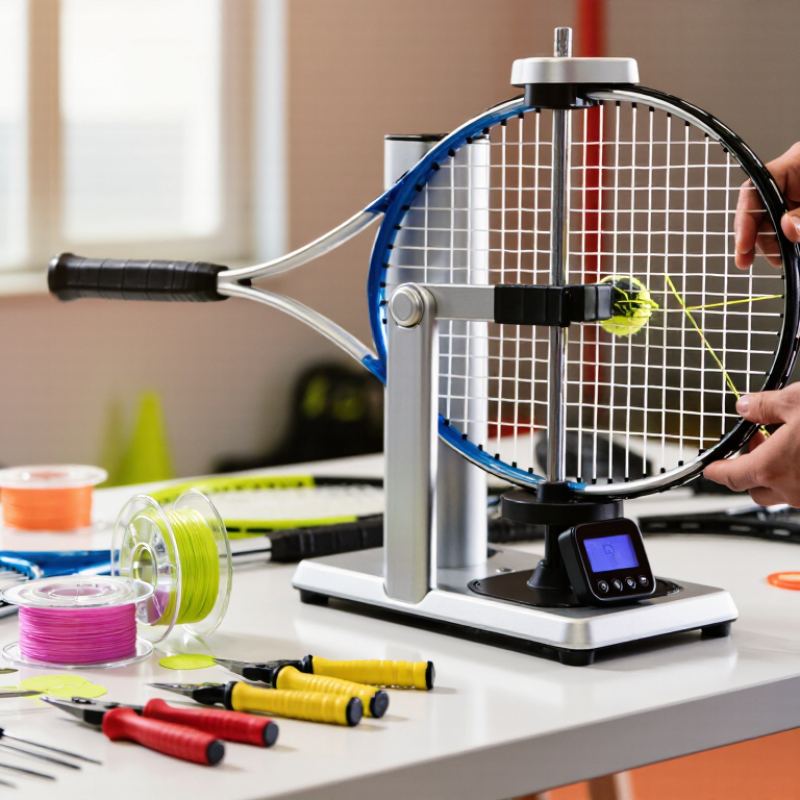
A racket restringing machine holds the frame securely while guiding string through its holes. Its main job is applying controlled tension to each string. This creates a more predictable string bed for play. The machine also uses clamps to keep tension from escaping between pulls. Small adjustments matter.
During restringing, the operator mounts the racket, checks its position, and follows the planned string pattern. A turntable helps the frame rotate smoothly. Tension controls let the user select different settings for mains and crosses. Some machines use a crank, while others use an electronic pulling system. Both can work well when handled carefully and checked regularly.
In my experience, a machine improves consistency, but it cannot correct careless technique. Uneven clamping may mark the string or change the final tension. Poor mounting can place unnecessary stress on the frame. Calibration also deserves attention. A setting on the display is not always the tension actually delivered. I once trusted a familiar setting too quickly and noticed a softer result than expected. That mistake showed me why test pulls and written records are useful. String type, gauge, temperature, and playing style can all influence the outcome. The machine provides control. The operator still provides judgment.

A racket restringing machine holds the frame securely while replacing worn strings. Its mounting supports protect the racket during tensioning. Clamps grip each string and keep it aligned. The tension head then pulls the string to a selected force. This process creates a more consistent string bed than hand tightening alone.
Small differences still matter. A loose clamp can reduce tension and change the racket’s response.
Most machines use a crank, drop weight, or electronic tension system. A drop-weight model relies on gravity and can offer dependable results when leveled correctly. Crank systems work faster, but they need regular tension checks. Electronic systems provide convenient adjustments, although calibration remains essential.
Experienced technicians usually test the machine with a tension gauge before important restringing work. This simple check can reveal inaccurate settings, damaged clamps, or uneven pulling.
Tips: Clean the clamps often, inspect the frame before mounting, and pull each string smoothly. Avoid sharp bends near the grommets. Record the racket’s string type, tension, and playing feel after each job. Your first results may not be perfect. That is normal. A careful note can show whether the tension was too firm, the knots were bulky, or the stringing pattern caused uneven spacing. Over time, this information helps players choose more reliable setups and helps the operator develop better control.
Key Benefits for Players and Stringers
A racket restringing machine gives players more control over comfort, power, and tension. Instead of waiting for a shop, you can adjust a racket when its response changes. I have found that a consistent setup makes mishits easier to understand. You notice whether the problem comes from technique, tension, or worn strings. A machine also helps stringers build practical experience. Each job teaches patience, measurement, and careful handling. The results are not always perfect. That is part of learning.
For regular players, restringing at home can reduce delays and long-term service costs. Stringers gain a repeatable workflow and can serve different playing styles. A beginner may prefer a softer response, while an advanced player may need firmer control. Accurate tension matters, but it is not the only factor. String type, racket condition, and local temperature can change the final feel. I once blamed tension for poor control, then noticed the frame was already damaged. That mistake changed my inspection routine.
Tips: Check the frame before mounting it. Keep tools clean and tension settings recorded. Start with moderate tension, then make small adjustments. Do not chase professional numbers without testing your own comfort. Allow extra time for your first few rackets. The process rewards care, but rushing can create uneven strings or unnecessary stress on the frame.
Why Buy a Racket Restringing Machine?
Types of Racket Restringing Machines
Racket restringing machines serve different users and budgets. A drop-weight machine uses gravity to create steady tension. It is simple, durable, and useful for home stringing. However, it works slowly and needs careful leveling.
A lockout crank machine speeds up repetitive work. Its tension head stops at a selected setting, then the stringer clamps the string. This design suits clubs, coaches, and small workshops. An electronic constant-pull machine keeps pulling until the tension stabilizes. It offers greater consistency, especially with polyester strings and frequent restringing. The ITF Global Tennis Report 2024 recorded 106 million tennis players worldwide. That large playing base supports growing demand for reliable racket maintenance, although machine ownership is not automatically profitable.
Tips: Match the machine to your weekly volume. Check clamp movement, tension accuracy, mounting stability, and replacement-part access. Test tension with a calibrated device, not only the machine display. A cheaper machine may become expensive after repeated adjustments. I have found that beginners often focus on speed and overlook clamp quality. That is a mistake. A machine can pull accurately, yet poor clamps can damage strings or create uneven tension. Professional stringers should also record racket type, string material, reference tension, and final results. The process becomes more dependable with evidence, not memory.
Comparison of the main racket restringing machine types, their operating principles, typical characteristics, and suitable applications.
| Machine Type | How It Works | Typical Tension Range | Tension Consistency | Main Advantages | Limitations | Best Suited For |
|---|---|---|---|---|---|---|
| Drop-Weight | A weighted bar uses gravity to apply tension. The bar is leveled by adjusting the string gripper position. | Approximately 9–90 lb (4–41 kg), depending on the model. | Consistent when the bar is correctly leveled; generally less affected by calibration drift. | Simple design, low maintenance, portable, and usually more affordable. | The operator must level the bar for every pull, which can make the process slower. | Home users, beginners, occasional restringing, and mobile stringing services. |
| Lockout / Crank | A hand crank pulls the string to a preset tension and locks when the target is reached. | Approximately 11–90 lb (5–41 kg), depending on the model. | Good repeatability when regularly checked with a tension calibrator. | Faster than a drop-weight machine, mechanically durable, and suitable for regular use. | The lockout design does not continuously compensate for string elongation after locking. | Club stringers, school programs, and users who restring multiple rackets each week. |
| Electronic Constant-Pull | An electric motor pulls the string and continues applying the selected tension while the string is clamped. | Commonly approximately 11–90 lb (5–41 kg), with model-specific limits. | Very high repeatability when the machine is correctly calibrated and maintained. | Fast operation, precise settings, programmable functions, and compensation for string relaxation. | Higher purchase cost, electrical dependence, and more components requiring service. | Professional stringers, busy shops, tournament services, and high-volume facilities. |
| Portable / Compact | A lightweight frame combines a compact mounting system with a manual or small electronic tension head. | Typically approximately 9–70 lb (4–32 kg), depending on the design. | Varies by tension system; stability depends strongly on the support surface and mounting quality. | Easy to transport, space-saving, and useful where a full-size machine is impractical. | Smaller supports may reduce workflow speed and require careful racket stabilization. | Traveling stringers, coaches, players with limited space, and event-side servicing. |
| Manual / Tabletop | String tension is applied with a hand-operated mechanism, while the racket is secured on a compact tabletop frame. | Often approximately 9–60 lb (4–27 kg), depending on the mechanism. | Dependent on operator technique, consistent measuring, and correct machine setup. | Low operating cost, compact footprint, and useful for learning the fundamentals of stringing. | Slower workflow and greater variation between pulls than constant-pull systems. | Beginners, personal use, demonstrations, and low-frequency restringing. |
| High-Volume Electronic | A heavy-duty electronic constant-pull system combines fast tensioning with rigid mounting and programmable operating controls. | Commonly approximately 11–90 lb (5–41 kg), subject to the machine specification. | Designed for highly repeatable results when calibration, clamps, and maintenance are controlled. | High throughput, reduced operator fatigue, strong frame stability, and repeatable racket preparation. | Largest investment, heavier footprint, and a greater need for routine inspection and service. | Retail service centers, academies, professional teams, and facilities with demanding workloads. |
Why Buy a Racket Restringing Machine?
Before buying a restringing machine, estimate your real workload. The SFIA 2024 Tennis Participation Report recorded 23.8 million U.S. tennis players in 2023. That growth may create steady local demand, but participation alone does not guarantee paid restringing work. Ask how many rackets you can realistically process each month. A home user may need a simple drop-weight machine. A busy stringer may need faster rotational tools.
Accuracy matters more than appearance. Compare tension consistency, mounting stability, clamp quality, and calibration options. The International Tennis Federation allows a broad range of racket specifications, but playing conditions and player preferences still affect tension choices. A machine with poor calibration can produce uneven results, even when the display looks precise. Test several pulls with a tension calibrator. Small errors become noticeable across a full racket.
Budget beyond the machine. Include string reels, cutters, replacement clamps, tools, and maintenance. A cheaper unit can become expensive when parts are difficult to replace. The United States Racquet Stringers Association has long emphasized calibration, technique, and documented procedures in professional stringing education. That guidance is useful, though not every workshop needs professional-level equipment. Consider noise, bench space, warranty support, and your learning time. I would also question optimistic payback estimates. Some rackets take longer than expected, especially when old strings are tangled or grommets need inspection.
© 2022-2025 Pelican Lakes Resort & Golf, All rights reserved | Privacy Policy
BROUGHT TO YOU BY THE WATER VALLEY COMPANY