Choosing one of the Top 10 Best UV Protection Golf Umbrellas for 2026 is about more than picking the largest canopy. On a bright tee box, glare off the fairway can make a round feel hotter, while a sudden gust can turn a flimsy umbrella inside out. A well-designed UV Protection Golf Umbrella should offer generous coverage, a sturdy frame, a comfortable grip, and a canopy that clearly states its sun-protection rating. Small details matter.
Dermatologist Dr. Darrell Rigel’s sun-safety guidance can be paraphrased this way: “Treat shade as one layer of protection, not the whole plan.” An umbrella can provide useful shade, but it does not replace sunscreen, protective clothing, or seeking shelter when conditions become severe. That distinction matters during long rounds, when players may spend hours outdoors and forget to reapply sunscreen.
This guide compares umbrellas by practical features, including canopy size, fabric claims, wind resistance, weight, handle design, and ease of carrying between holes. We also consider how each model may suit different golfers, from walkers who need a lighter option to cart users who value broad coverage. A higher price does not automatically mean better protection, and published UV ratings should be checked against the manufacturer’s specifications. Some product details can be difficult to compare consistently. That is worth keeping in mind. Use the list as a starting point, then match the umbrella to your course, climate, and playing habits.
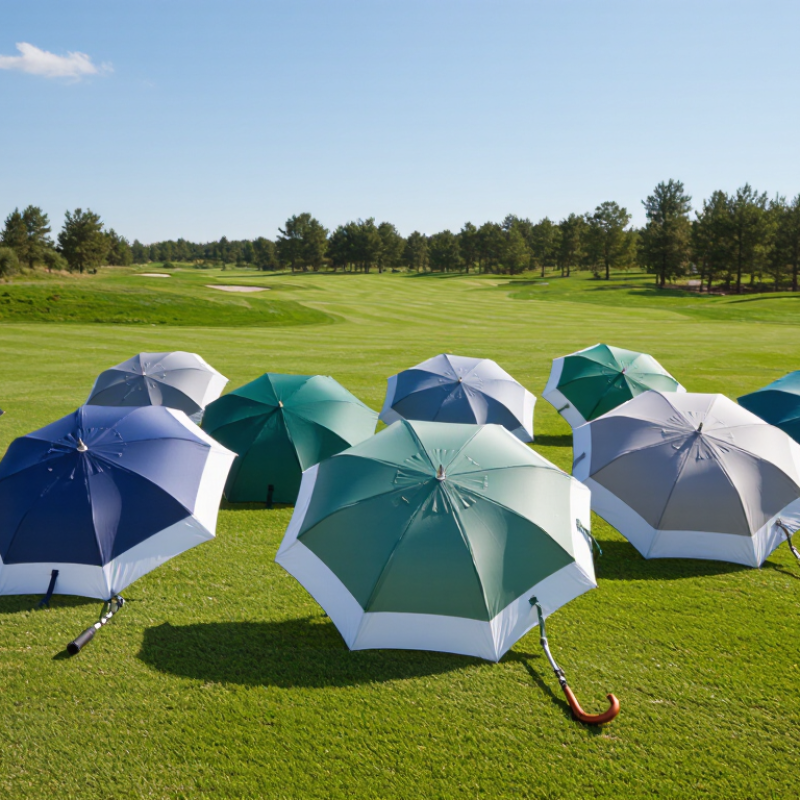
UV protection in a golf umbrella depends on its canopy fabric, not just its color.
A dense weave or UV-blocking treatment reduces how much ultraviolet radiation passes through. Some umbrellas carry a UPF rating, which indicates tested protection through the fabric.
UPF 50, for example, allows about one-fiftieth of the tested UV radiation to pass through.
Check the product label; ordinary shade is not the same as verified UV protection. Small details matter. Seams, stretched fabric, and wear can affect coverage over time.
On a sunny tee, the canopy can shade your head, neck, and shoulders while you wait or walk. But sunlight also reaches skin from the side and reflects off bright surfaces. Wind can tilt the umbrella, leaving an arm exposed.
It is useful, not complete. Pair it with sunscreen, a hat, and covered clothing, especially during long rounds.
One honest drawback: holding an umbrella for several holes can feel awkward, and shade shifts as the sun moves. Choose a canopy size you can manage, then check its condition each season.
A golf umbrella’s canopy matters more than its color when blocking sunlight. Look for a clear UPF rating or documented UV-testing information; dark fabric alone does not prove strong protection. A wider canopy can shade your shoulders, bag, and hands, but coverage changes as the sun moves. Check the stated diameter and whether the fabric stays taut, since sagging panels can leave gaps.
Small detail. A vented canopy may handle gusts better, though it will not make an umbrella windproof. On exposed fairways, wind can turn even a sturdy umbrella awkward.
Tips: Tilt the canopy toward the sun, then adjust it as your direction changes. Keep sunscreen and a hat in your routine; an umbrella cannot block every reflected ray. Check that the handle feels secure when held for several holes, not just in a shop.
For regular rounds, balance shade with weight and ease of opening. A large model offers more coverage but can crowd a cart path or feel tiring to carry. A comfortable grip and a reliable opening mechanism matter when the weather shifts between holes. Check seams and fabric after use, especially if the umbrella was packed away damp. No design solves every course condition, and I would not choose by size alone. Test how it feels in your hand.
For 2026, a useful top-ten guide to UV-protection golf umbrellas should compare more than canopy size. Look for clear information about the fabric’s UV protection, such as a stated UPF rating or test details. A broad canopy can shade your shoulders and bag, but it may feel awkward in crowded paths. Check the open diameter, shaft length, grip, and weight before choosing. Wind resistance matters, too. A vented canopy may release some pressure in gusts, though no umbrella is storm-proof. Small details count: a comfortable handle feels different after several holes, and a secure strap helps when the umbrella is folded. More coverage is not always better.
Tips: Check the UV details, not just “sun protection” wording. Try the grip with a gloved hand. Make sure the folded umbrella fits your golf bag.
Match the umbrella to your usual course conditions. On exposed fairways, dependable shade can reduce direct sun on your face and neck. Still, an umbrella cannot cover every angle, especially when the sun shifts. Pair it with other sun-protective habits, and follow local weather guidance. I would not choose by a ranking alone; product claims and real comfort can differ. A canopy that looks ideal online may feel heavy after a long walk. That is easy to miss.
UV protection benchmarks for comparing golf umbrella fabrics
Bars show the minimum UV blocked implied by each UPF rating, calculated as (1 − 1/UPF) × 100. UPF 50+ means at least 98% UV blocked. These are rating benchmarks, not test results or rankings of specific umbrellas; actual protection depends on the product and conditions.
A useful comparison of UV-protection golf umbrellas starts with coverage, not the canopy’s advertised diameter. Check the usable shade beneath it, especially when the sun is low and you are carrying a bag. A wide canopy can cover a player and part of a golf bag, but it may feel awkward in a crowded cart or strong wind. That trade-off is easy to miss. A vented canopy may release some wind pressure, though it does not make an umbrella storm-proof. Look for a sturdy frame, reinforced joints, and a handle that stays comfortable during a long round.
Durability affects value more than a low shelf price suggests. Open and close the umbrella several times, if possible, and check whether its ribs flex smoothly rather than catching. Inspect the stitching around the canopy and the shaft for loose parts. A UV-rated fabric can help limit sun exposure, but coverage changes with your angle, cloud cover, and time on the course; no umbrella blocks every ray. For frequent players, a replaceable or repairable component may be worth paying extra for. For occasional use, a lighter model with reliable shade may be the better buy. I would not rank price alone. It is tempting, but misleading. The best match depends on how much shade you need, how carefully you handle gear, and whether the umbrella still feels secure after repeated rounds.
This brand-free comparison ranks common golf-umbrella configurations for different needs. Canopy spans and weights are typical shopping ranges, not measurements of specific products. UV protection depends on the fabric’s tested rating, canopy condition, and exposure angle.
| Rank | Umbrella Profile | Typical Canopy Span | UV Protection to Look For | Common Frame Construction | Typical Weight | Durability Outlook | Value Outlook | Best For |
|---|---|---|---|---|---|---|---|---|
| 1 | Oversized vented double canopy | 68–72 in (173–183 cm) | UPF 50+ stated for the canopy fabric | Fiberglass ribs; reinforced shaft | 1.8–2.6 lb (0.8–1.2 kg) | High when ribs and vent seams are reinforced; vents can reduce wind pressure | High for golfers needing broad shade and wind handling | Maximum coverage on exposed courses |
| 2 | Large vented single canopy | 62–68 in (157–173 cm) | Choose a fabric with a verified UPF 50+ rating | Fiberglass ribs; metal or composite shaft | 1.6–2.3 lb (0.7–1.0 kg) | Good; vent construction and rib joints are key inspection points | Very good when priced below oversized designs | Reliable all-round golf use |
| 3 | Large double-canopy model | 62–68 in (157–173 cm) | UPF 50+ if explicitly tested and listed | Fiberglass or mixed-material ribs; vented canopy | 1.7–2.5 lb (0.8–1.1 kg) | Good to high; extra panel seams should be well stitched | Good if wind performance matters more than minimum weight | Windy conditions and shared shade |
| 4 | Classic large single canopy | 60–66 in (152–168 cm) | Look for a labeled UPF 50+ fabric rating | Steel or fiberglass ribs; straight shaft | 1.4–2.1 lb (0.6–1.0 kg) | Moderate to good; depends on rib strength and stitching | Often a practical balance of price and coverage | Everyday golfers seeking a straightforward design |
| 5 | Extra-wide UV-focused canopy | 68–72 in (173–183 cm) | Prefer UPF 50+ fabric with rating details from the seller | Fiberglass ribs; reinforced canopy edges | 1.8–2.7 lb (0.8–1.2 kg) | Good if the wide canopy is supported by sturdy ribs | Good for users who prioritize shade over compact storage | Strong sun exposure and larger users |
| 6 | Lightweight vented golf umbrella | 58–64 in (147–163 cm) | UPF 50+ is a useful target; confirm the fabric rating | Fiberglass ribs; lightweight shaft | 1.2–1.8 lb (0.5–0.8 kg) | Moderate to good; lower weight can mean less robust hardware | Very good for walkers if construction is adequately reinforced | Walking golfers who want reduced carry weight |
| 7 | Compact folding sun umbrella | 48–56 in (122–142 cm) | Check for an explicit UPF 50+ claim on the canopy | Multi-section shaft; compact folding ribs | 1.0–1.6 lb (0.45–0.7 kg) | Moderate; folding joints need careful handling and storage | Good for portability, but offers less coverage per person | Travel, occasional rounds, or limited storage space |
| 8 | Large manual-open golf umbrella | 60–68 in (152–173 cm) | Choose a tested UPF-rated fabric rather than relying on color alone | Fiberglass or steel ribs; manual runner | 1.5–2.3 lb (0.7–1.0 kg) | Good; a simpler opening mechanism has fewer moving parts | Often strong for buyers who prefer mechanical simplicity | Users prioritizing a straightforward mechanism |
| 9 | Large auto-open golf umbrella | 58–66 in (147–168 cm) | Look for a published UPF rating for the canopy material | Fiberglass ribs; spring-assisted opening mechanism | 1.6–2.4 lb (0.7–1.1 kg) | Moderate to good; the release mechanism adds a part that may require care | Good when quick one-handed opening is useful | Convenient opening between shots |
| 10 | Budget large-canopy umbrella | 58–64 in (147–163 cm) | Buy only if UV protection is clearly specified; a dark canopy alone does not confirm UPF | Typically steel or fiberglass ribs; construction varies | 1.4–2.2 lb (0.6–1.0 kg) | Variable; check rib attachment, stitching, and warranty terms | High upfront value, but durability varies by construction | Occasional use and tighter budgets |
Buying note: UPF 50 fabric transmits no more than 1/50 of the tested UV radiation (about 2%) under the test conditions; this rating does not guarantee complete protection from reflected or side-angle sunlight. For a fair product comparison, verify the current canopy span, weight, UPF test information, warranty, and wind-use guidance in each product’s listing.
Choosing a UV protection golf umbrella starts with its canopy, not its color. Look for a clear UPF rating or stated UV-blocking test; dark fabric alone is not proof. A wide canopy can shade your shoulders and golf bag, but check that it still feels manageable in a gust. Vented panels may help release trapped wind. Open and close the umbrella a few times before buying. The mechanism should move smoothly, without pinching or sticking.
The frame matters on an exposed course. Flexible ribs and a sturdy shaft can handle everyday wind better than a flimsy build, though no umbrella is storm-proof. Check the handle for a secure, comfortable grip, especially if you wear a glove. Feel the difference. I used to focus too much on canopy size; a huge umbrella can be awkward when moving between shots. A little less coverage may be more practical.
Care keeps the fabric and moving parts in better shape. After a wet round, leave the umbrella fully open in a shaded, airy spot until dry. Folding it damp can invite mildew and leave an unpleasant smell. Brush off loose dirt, then wipe stains with mild soap and water. Skip harsh cleaners and direct high heat, which may weaken coatings or fabric. Check the ribs, joints, and stitching now and then. Small snags are easy to miss. Replace a loose tip or damaged part only if the maker offers a suitable repair; I have waited too long on that before.
© 2022-2025 Pelican Lakes Resort & Golf, All rights reserved | Privacy Policy
BROUGHT TO YOU BY THE WATER VALLEY COMPANY